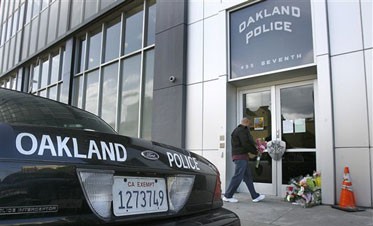
There is sad news from Oakland, California, as I am sure all of you know by now. One violent punk took out four experienced and tested law enforcement officers, all members of an agency that pulls no punches. Before I go any further, know that nothing I say is intended to belittle those officers, their ability, or their sacrifice. We all mourn with our colleagues in the Bay Area as they honor their dead. Meanwhile, they continue to attend roll calls, hit the street, and answer calls for service, good news or bad, because that is what cops do.
Because of the gravity of this incident, we are going to see it dissected to death in the months to come. I don't know how much we will ever know about what happened during the traffic stop that precipitated the incident.
Lovelle Mixon, age 26, was a convicted felon who had already spent time in Corcoran State Prison after a conviction for assault with a deadly weapon following his participation in an armed robbery. He was paroled once in 2007, violated the terms of his parole and was sent back for nine more months. He got out again in November 2008. Three weeks ago, he missed a home visit by his parole officer and was "violated." Mixon's grandmother said he was angry because his parole officer had missed previous appointments.
There was a "no bail" arrest warrant outstanding for Mixon on that parole violation at the time he was stopped. Mixon probably knew this–the officers who stopped him probably didn't. Mixon was reportedly despondent about not being able to find a job, and feared being returned to prison. If he had been sent back to prison, he would have done, at most, six months. His remedy to this was to arm himself with a semi-auto handgun and an AK-47 military rifle.
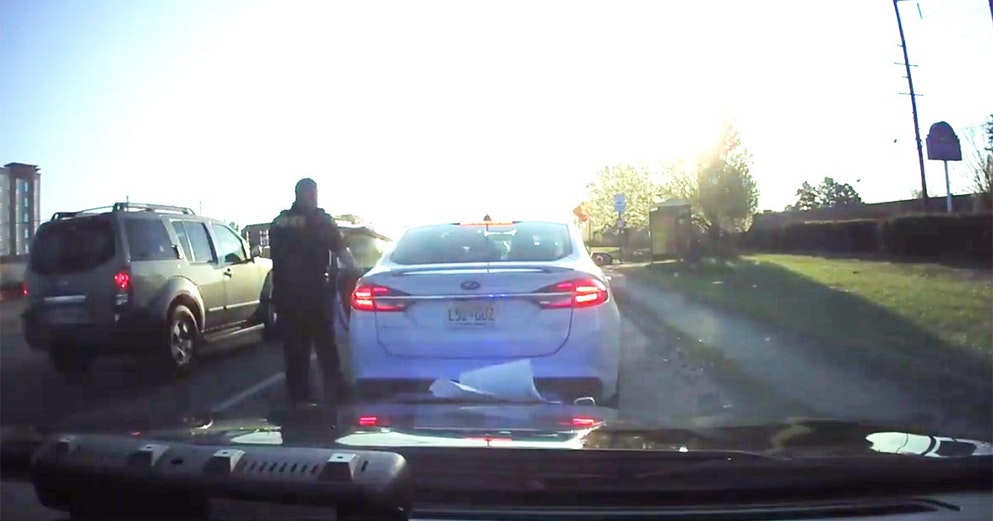
Traffic officers Sgt. Mark Dunakin and Officer John Hege, riding motorcycles, stopped Mixon's 1995 Buick LeBaron on MacArthur Blvd., in Oakland. MacArthur Blvd. is one of the "main drags" in Oakland, and the location is only a couple of blocks from the large Eastmont Town Center mall. Sgt. Dunakin radioed he was about to make the stop, then walked up to Mixon to ask for his driver's license. Dunakin then brought the paperwork back to his bike. It was at this time that Mixon got out of his car and fired his handgun at both officers.
News accounts report that the first sign that something had gone wrong came from a call made by a citizen to the effect that two officers were down. By the time backup officers reached them, Dunakin was dead and Hege was just hanging on. At this writing, Hege has been declared brain dead and is being maintained on life support as an organ donor.
As officers cleared the scene of the first shooting for investigators, one account reports that about 20 people taunted the police personnel there, saying the killings were "payback for Oscar." The reference is to Oscar Grant, who was shot and killed by a Bay Area Rapid Transit (BART) Police officer in Januaryat the Fruitvale BART Station, also located in Oakland.
Mixon fled to an apartment about a block away from the first shooting, near Hillside St. and 74th Ave. An informant had led them to the apartment of Mixon's sister. Sgt. Ervin Romans and Daniel Sakai were hit by Mixon's rifle fire almost immediately after entering the apartment, both in the head. A third officer, OPD Sgt. Pat Gonzales, was hit in the shoulder, with another bullet ricocheting from his helmet. He was treated at the hospital and released.
This was certainly the bloodiest day in Oakland PD history, but it's still second place to the infamous "Newhall Massacre" on April 6, 1970. Four officers of the California Highway Patrol stopped Jack Twinning and Bobby Davis off of U.S. Highway 99 north of Los Angeles, in Newhall. Twinning and Davis were career criminals who were planning a new string of robberies. They had amassed a substantial arsenal of firearms and ammunition, and had been seen brandishing guns at other motorists on Highway 99. A report from one of those motorists lead the CHP to stop their red Pontiac.
Both the suspects and officers exchanged fire with handguns and shotguns. All four officers were killed at the scene. Other than one shotgun pellet that struck Twinning in the forehead to make a superficial wound, the only effective shot fired against Twinning and Davis was from a passing citizen, Gary Kness. Kness picked up the .38 revolver dropped by a fallen officer and fired at Davis. All his rounds struck the Pontiac, but a bullet fragment did penetrate Davis' chest. Kness ran from the scene and survived the gunfight. Twinning ran to a house where he took hostages and created a standoff with police that lasted several hours. He eventually released his hostages, then killed himself with a shotgun taken from one of the CHP officers. Davis was captured, convicted, and sentenced to death. His death sentence was overturned in 1972 and converted to life imprisonment.
The Newhall incident was analyzed thoroughly, and revealed a number of shortcomings in training and equipment. These shortcomings weren't limited to the California Highway Patrol. They were standard practices used by most law enforcement agencies of the United States at that time. These included:
- Firearms range practices–some of the Newhall officers were found with spent brass in their trouser pockets. At the CHP Academy, they had always emptied their revolvers' empty cartridges into their hands, then putting the brass in their pockets. This kept the range nice and tidy, but it added a few seconds to the time required to reload. Neither handgun nor shotgun practice included any tactical drills. It was more like, "approach the firing line, ready, fire." The notion that the officer might need to move, seek cover, or reload under fire wasn't considered.
- Training ammunition–officers were trained with cheaper .38 Special ammunition, even though many would carry .357 Magnum revolvers and ammunition. The difference in recoil between a .357 and a .38 round is significant, and it's not the kind of thing you want to experience for the first time in a live gunfight. This was exactly what some of the CHP officers did. They also had very little training with their Remington 870 pump shotguns, even though these are highly effective weapons. One officer fired so fast he ejected one of the four live shells he had to use. He wasn't supplied reloads. Another approached the suspects with his shotgun at "port arms," and was struck down by two .357 Magnum rounds before he could even bring the weapon to bear on the suspects.
- Equipment–officers were issued "dump pouches" for handgun ammunition reloads, so that each round had to be inserted into the revolver cylinder one at a time. "Speedloader" devices that load all six into the cylinder at once were available, but their use was forbidden. Officers had four shells loaded into the magazine of their shotguns. When those were gone, they were out.
Law enforcement training changed markedly after Newhall. No one would argue that the price paid for that change was worth it, although the lessons learned and changes in training have saved many officers' lives since.
Will the events of March 21, 2009 have as great an impact on police training? I doubt it. Oakland PD trains their people well. Their city is a violent place. When I was in college in the 1970s, just down the road from Oakland, I read a statistic that asserted that the life expectancy of a man 16-25 years old on the streets of Oakland was less than that of an infantryman on active duty in Vietnam. I've never heard anyone posit that the training given to OPD officers was inferior in any way.
This is only conjecture, but my take is that the victims in this incident just didn't expect Lovell Mixon, the armaments he carried, and the attack-dog aggression that he displayed against the officers. I can think of any number of times that someone like Mixon could have taken me, because I wasn't ready to go to war that day. There are limits to just how hypervigilant one can be before it becomes self-destructive, but I think the time may be here to click the vigilance knob up a notch. There are more Lovell Mixons out there.
Mark Dunakin, John Hege, Ervin Romans, and Daniel Sakai, rest in peace. Your watch is over, and we honor your service and sacrifice. I hope we can learn something from your passing–but this lesson won't be worth the price, either.